Smart door locks, also known as smart locks, are enjoying increasing popularity, and for good reason. They offer significantly greater convenience than traditional house keys: the door can be opened via smartphone, fingerprint, or even automatically via geofencing, without having to use a classic key. It is precisely this flexibility, the security gain, and the ability to selectively grant access or control it remotely that make smart locks appealing to many.
For whom is retrofitting worthwhile at all?
In principle, smart locks are suitable for a wide target group: tenants benefit from the simple, usually reversible installation and greater everyday convenience; owners can specifically secure their house and use smart functions. Even companies or vacation rental owners benefit from the flexible access options for guests or staff – often even without extensive modifications.
However, no one should invest hastily without thorough information. In this guide, you will learn what really matters when retrofitting: from technical requirements and legal frameworks to key security aspects and the most important functions, as well as a market overview, buying advice, and installation. This way, you can decide if and how a smart lock is really worthwhile – for your home, apartment, or business.
What are Smart Locks?
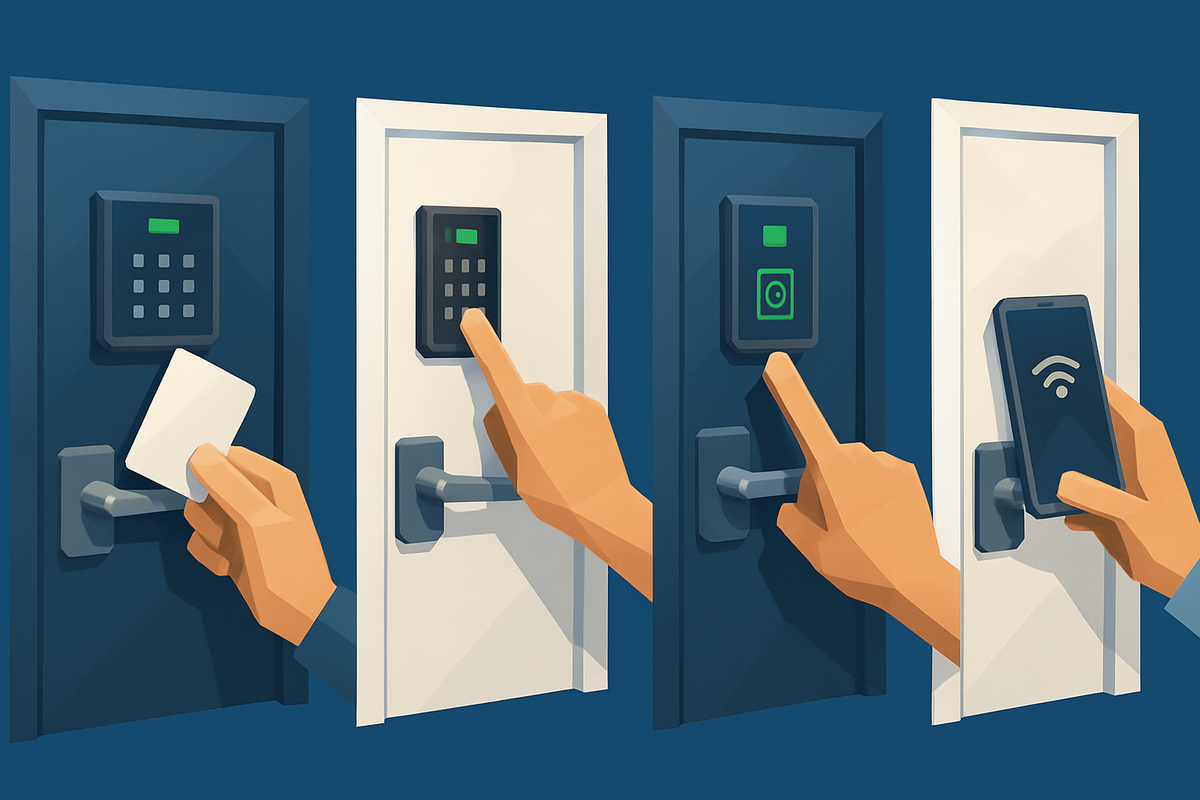
Smart locks – or smart door locks – are electronic locks that digitally regulate access to apartments, houses, or offices. Unlike classic mechanical keys, opening and locking is done via smartphone app, PIN code, fingerprint, transponder (RFID), or remote control. Many models can also still be operated with a classic key, which increases everyday flexibility.
At its core, a smart lock works with wireless transmission (Bluetooth, WLAN, NFC) and uses modern encryption. It not only regulates access but often logs all entries, warns of tampering attempts, and can grant temporary access rights to guests or service providers.
Advantages over classic locks
- Convenience: No more searching for keys or the risk of losing them – the door opens automatically, for example, as soon as you approach, or conveniently via app.
- Flexibility: Temporary access rights can be easily created or deleted – ideal for family, friends, holiday guests, or tradespeople.
- Security: Modern encryption, access logs, and often alarm functions offer added security. In case of key loss, simply deleting digital access rights is sufficient; cylinder replacement is usually unnecessary.
- Remote control: This allows doors to be monitored or locked and unlocked even when you're on the go.
- Easy integration: Many models can be integrated into smart home systems or alarm systems, offering many automation options.
Typical use cases and examples from everyday life:
- Private household: Family members receive individual authorizations, the cleaning staff only gets access on Wednesdays – all controlled via app.
- Vacation rentals: Guests receive a code for the booked period, which expires automatically; no more key chaos when visitors change.
- Businesses: Flexible access regulations for employees, time tracking, and transparent control of access to sensitive areas.
- Service and everyday life: Package delivery or tradespeople can be granted targeted access for a period, without anyone having to be present in person.
- Accessibility: Elderly people or people with disabilities benefit from keyless, simple operation at the touch of a button.
Thus, smart locks are long since more than just a technical gadget – they enable convenient, flexible, and secure access solutions for many situations in life.
Check suitability: Does a Smart Lock fit your door?
Before you decide on a smart lock, you should know what type of door cylinder you have. In Europe, three types are widely used:
-
Euro profile cylinder: Most common, often found on front doors. Recognizable by its elongated, "lying eight" shape with a distinctive notch.
-
Swiss Round Cylinder: Mainly used in Switzerland, round profile – sometimes requires special adapters.
- Scandinavian Cylinder: Oval shape, predominantly in Nordic countries, less common, but ensure your smart lock is compatible.
Many manufacturers offer compatibility lists or adapters for special designs.
Necessity and procedure of correct measurement
To ensure that a smart lock fits and functions optimally, precise measurement of the cylinder is crucial:
- Measure cylinder length: Determine the length from the center of the mounting screw to the outside and inside of your door (e.g., 30/35mm).
- Check profile: Does the lock fit on/in your existing cylinder?
- Consider drillings & fittings: The cylinder must not protrude too far from the fitting, otherwise security gaps may arise.
Many smart locks are mounted directly on the existing lock, but for some doors, cylinder replacement is necessary. Most providers offer step-by-step instructions for measuring and the most important dimensions online.
Special features: core pulling protection, emergency and panic function, knob vs. handle
- Core pulling protection: For higher-quality doors, a core pulling protection prevents the cylinder from being pulled out. Check whether your lock has such protection and whether the desired smart lock can be mounted on it. A special rosette may be necessary.
- Emergency or panic function: This function ensures that the door can still be opened from the outside even if a key is stuck on the inside. Practical for households with multiple residents or as a security aspect in rental apartments and offices.
- Knob or handle: When installing, you decide between a knob (which is only opened by turning from the inside) or a handle (mechanically and electronically operable). Both variants have advantages and disadvantages: the knob offers higher security, the handle more flexibility and convenient access.
Conclusion: Not every door is immediately suitable for every smart lock! Checking the cylinder, precise measurement, and considering additional functions such as core pulling protection or emergency mechanisms are absolutely necessary to enable simple and secure retrofitting.
Our team will be happy to assist you. You can find all ways to contact us here.
Important Purchase Criteria
Compatibility with existing doors and cylinders
Most smart door locks are designed for Euro profile cylinders, which are standard in Central Europe. However, it is important to check before purchasing whether your cylinder is compatible and, if necessary, which door thickness is supported. For multi-point locks, pull protection, or atypical door types, a compatibility check is also recommended, as well as, if necessary, replacing the cylinder or using an adapter.